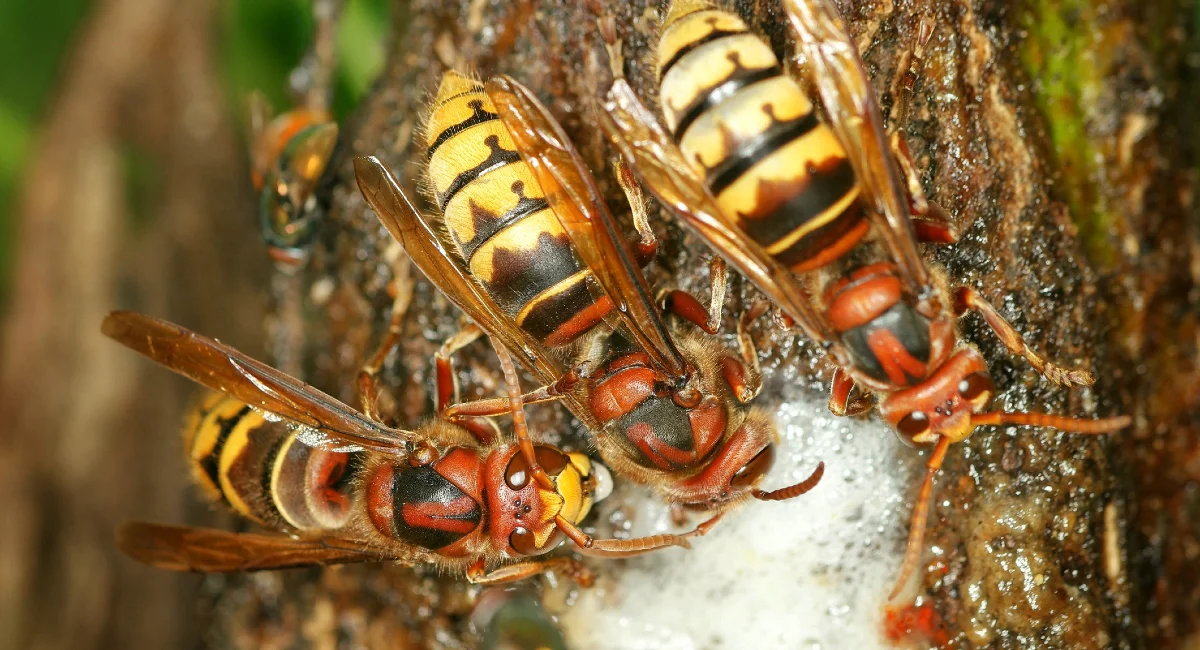
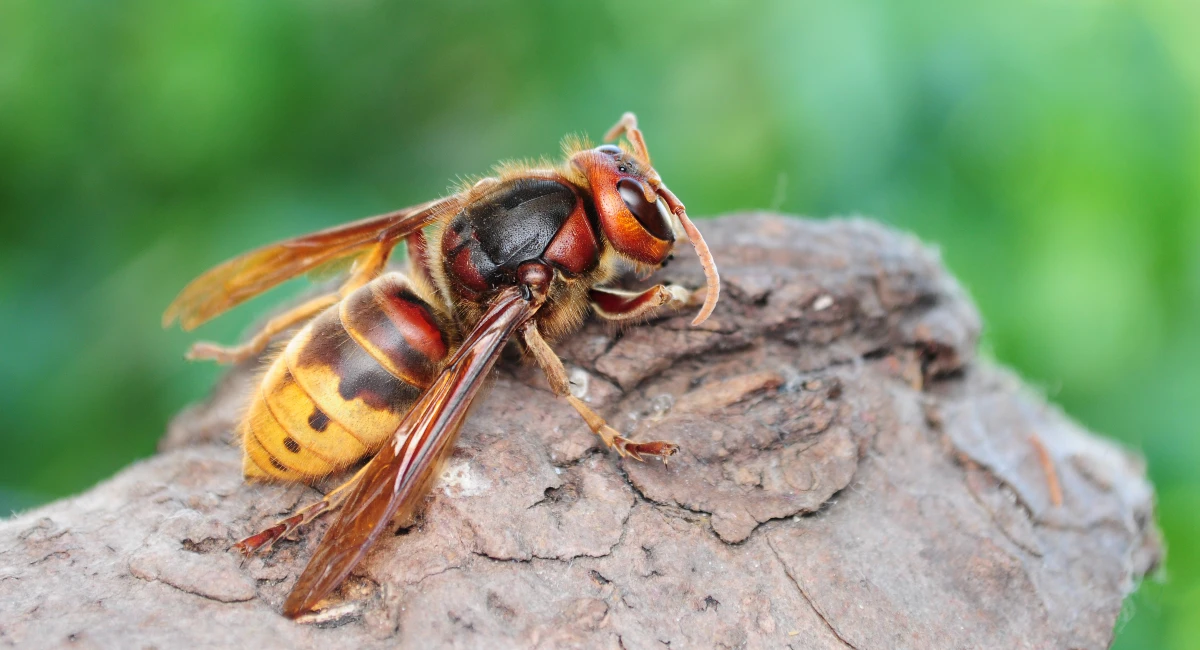
European hornets (Vespa crabro), one of the largest wasp species in North America, were originally introduced from Europe in the 1800s. Known for their impressive size and reddish-brown coloration with yellow markings, these wasps have adapted to diverse habitats, including forests, grasslands, and suburban areas. Unlike many other types of hornets and wasps, European hornets are capable of nocturnal activity due to their large compound eyes, which enhance their vision in low light.
European hornets and European wasps are often confused, but they are distinct species with unique characteristics. European hornets are larger, with reddish-brown and yellow markings, and tend to be less aggressive than their wasp counterparts. In contrast, European wasps are smaller, more aggressive, and have a distinctive yellow-and-black striped appearance.
Characteristics & identification
European hornets are distinct due to their size, reaching one to one and a half inches (25-38 mm) in length, making them one of the largest wasp species. Their bodies are yellow and brown striped, with reddish-brown heads and thoraxes.
Unlike bees, which have barbed stingers and can only sting once, European hornets have smooth stingers, allowing them to sting multiple times without harming themselves. They also have powerful mandibles, which they use to hunt and dismember various insects, including grasshoppers and flies, which they feed to their larvae.
These hornets are identifiable by their characteristic size and color patterns. They build large, enclosed nests in hollow trees, attics, or wall voids. European hornet nests are generally sheltered in dark, protected areas, unlike bald-faced hornets, which construct exposed paper nests in trees. They are also less visible and are typically found near dense vegetation or shaded areas.
Curious about hornets? Learn more about their behavior and habitats.