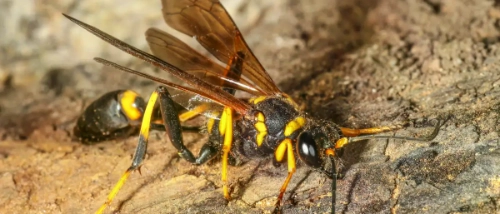
Mud dauber wasps, known for their solitary nature and distinctive mud nests, are often seen as helpful residents in human spaces due to their role in controlling spider populations.
Unlike other social wasps, mud daubers are non-territorial and rarely interact with humans. Though less harmful than other wasps, mud daubers sometimes nest on homes and buildings, leading some to seek their removal.
Characteristics
Unlike social wasps, mud daubers are solitary and docile, posing little to no risk to humans. They are also unique in their nesting habits, constructing tube-like nests out of mud rather than paper-like materials.
A female mud dauber deposits a paralyzed spider in each cell for her larva to feed on when it hatches. This diet provides natural pest control, making mud daubers beneficial in controlling spider populations.
Curious about wasps? Learn more about their behavior, habitats, and how to manage them effectively.
Identification
Mud dauber wasps are slender, with a characteristic narrow ‘waist’ between the thorax and abdomen that distinguishes them from social wasps. Depending on the species, they range in size from around 10 to 25 mm and are often black, metallic blue, or iridescent green.
With their long, thin bodies, mud daubers look different from the stocky yellow-and-black-striped wasps commonly associated with aggression.
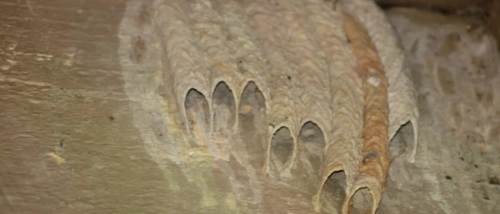
Also, mud dauber nests are usually the most visible indicator of their presence. These distinctive nests are built from multiple layers of mud and shaped into tubes or organ-pipe-like structures. They can appear under eaves, in sheds, or on walls.
Unlike the papery nests of social wasps, mud dauber nests are smooth, with a hardened mud appearance, and usually contain only one larva per cell, unlike the crowded communal nests of social wasps.