Temps and termites are on the rise. Schedule your free inspection today.

800-837-5520 Call us for a free quote Contact us

Tick facts and information

Do you like spending time outside in the spring and summer? While you and your family members enjoy the great outdoors, ticks may be there too, waiting in the brush for a meal.

Why should you be concerned about ticks? Ticks are responsible for transmitting many diseases to both humans and animals. Of all arthropods, ticks spread the widest array of disease-causing organisms. When ticks feed on human blood, they are capable of transmitting diseases such as Lyme disease, Rocky Mountain spotted fever, tick paralysis and more. Read on to learn helpful tick information and facts to help you spot the signs and learn how to minimize your chances of bringing them inside.

If you would like to learn more about our tick prevention services, call Ehrlich Pest Control at 800-837-5520 or sign up for a free pest inspection online.

Contact your local tick control expert

* Required field

Download this report

What are ticks?

Ticks are small, parasitic arachnids that feed on the blood of humans and animals. Unlike insects, which have six legs, adult ticks have eight. They belong to the same family as spiders and mites. 

Ticks go through four life stages: egg, larva, nymph, and adult. They need a blood meal at each feeding stage to grow and survive. They depend on hosts for food, so you can often find them in grassy or wooded areas where animals or people pass by. Most tick bites are harmless. However, some ticks can carry bacteria and viruses that cause illness.

Learning everything about ticks can help homeowners recognize tick activity early and take steps to reduce the risk of infestation and bites.

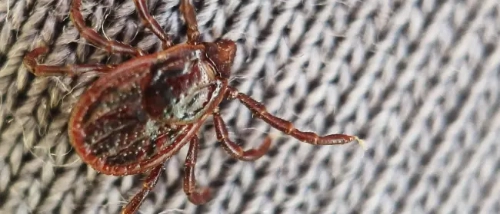
tick climbing on clothing

What do ticks look like?

Ticks are very small, flat-bodied arachnids that can be hard to spot until they’ve fed. Adult ticks usually measure about one-eighth of an inch long, though they can appear larger after feeding. Their bodies are oval and reddish-brown, with eight legs and no wings or antennae. 

Young ticks, called nymphs, are even smaller, about the size of a poppy seed. Because of their size, they’re often mistaken for freckles or specks of dirt. 

When a tick feeds, its body swells and darkens in color as it fills with blood. Spotting these changes can help you identify an attached tick more easily.

Common tick species in the U.S.

There are several types of ticks found across the United States, each with its own preferred environment and host.  

Blacklegged ticks (deer tick): this species is best known for spreading Lyme disease. Adult females have reddish-brown bodies, while males are darker.

American dog ticks: common in grassy fields and along walkways, this tick can transmit Rocky Mountain spotted fever. It has a brown body with gray or silver markings on its back.

Brown dog ticks: unlike most ticks, this species can complete its entire life cycle indoors. It primarily feeds on dogs and is found throughout the country, especially in warm climates.

Understanding where ticks are most likely to be found and the diseases they may transmit can help you take the proper steps to protect your family and pets year-round.

Do you need professional tick control services?

Despite the best prevention efforts, ticks can still find their way into yards and outdoor spaces. Because ticks breed and hide in hard-to-reach areas, professional treatment is often the most effective way to reduce their presence.

Ehrlich takes a comprehensive approach to tick control for your yard. We begin by thoroughly inspecting your property to identify tick hotspots and develop a customized treatment plan. Our treatments help eliminate existing ticks and create a barrier using effective acaricides, residual materials that remove ticks. Our technicians focus on where ticks are commonly found, including perimeter vegetation, overgrown grassy areas, and frequently traveled footpaths.

The secret of Ehrlich’s success in the pest control industry for over 100 years is due to the expertise and skill of our technicians. Having graduated from our intensive training program, Ehrlich technicians are trained to quickly identify your pest problems and apply treatments, effectively and non-intrusively.

Ehrlich technicians are experts in tick biology and behavior. By clearly understanding how ticks behave, your technician can help treat properties for ticks and other pests most effectively.
Frequently asked tick control questions

The most effective way to manage ticks is with professional tick control. While DIY sprays and treatments may offer temporary relief, they rarely address ticks at all life stages and are unlikely to provide ongoing protection. Professional tick services and inspections are the most effective method for long-term tick prevention.

Ticks thrive in warm, humid environments, making the late spring and summer months the most favorable for their activity. They are commonly found in areas with dense vegetation, such as tall grasses, shrubs, and forested regions, where they can easily latch onto passing hosts. Depending on the species, ticks can be active at any time during the day.

A tick bite often appears as a small, red bump, sometimes with a darker center, and may be itchy. The potential side effects from a tick bite can range from localized reactions like swelling and rash to more severe, systemic illnesses. Tick-borne illnesses like Lyme disease and Rocky Mountain spotted fever can cause symptoms such as fever, chills, tiredness, muscle pain, and joint pain. If you believe you have been bitten by a tick, it’s best to consult your doctor and seek medical help.

Ticks live in grassy, wooded, or brushy areas where animals and people often pass. They thrive in humid environments and can be found near tall grass, shrubs, and leaf piles.

Ticks don’t jump or fly; they wait on vegetation for a passing host. When people or pets brush against these surfaces, ticks quickly climb onto them to find a place to feed. 

Ticks feed on the blood of mammals, birds, and sometimes reptiles to survive and reproduce. They use specialized mouthparts to attach securely while feeding for several days.

Yes, ticks can carry bacteria and viruses that cause diseases like Lyme disease and Rocky Mountain spotted fever. Not every tick bite leads to illness, but some can pose serious health risks. Learning facts about ticks and the diseases they can spread can help arm you with the knowledge to spot any signs or symptoms from bites early.

Ticks can remain attached for anywhere from one to several days, depending on their life stage and species. The longer a tick feeds, the greater the chance of disease transmission. Checking for ticks daily and removing them promptly is an essential part of prevention.

Find your local branch

Ticks have several serious health risks associated with them. Find out how to get rid of ticks.