Temps and termites are on the rise. Schedule your free inspection today.

800-837-5520 Call us for a free quote Contact us

Differences between moles, voles, and shrews

Oftentimes our customers call us to report seeing a small, mouse-like creature scurrying around their landscape. Typically, customers notice burrows in their mulch, or runways that part the grass or in the snow. The culprits are little creatures commonly referred to as moles, but in reality, they may actually be a molevole or a shrew.  

Why is it important to distinguish which one you are dealing with? Well, like most of the pests that we deal with, proper identification is critical because each has different characteristics that will help dictate the best management strategy. To an untrained eye, the difference between a vole vs. mole can be subtle and it can also be difficult to distinguish a vole vs. a shrew, which is why any pest in the yard needs a professional assessment.

If your home or property has been experiencing issues with moles, voles or shrews, contact the experts at Ehrlich online or call us at 800-837-5520 to discuss possible solutions for the problem.

A mole on a white background

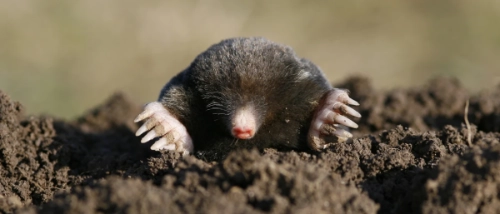
Mole anatomy and characteristics

  • Moles have a pointed snout
  • Moles have enlarged front feet used for digging
  • Moles have eyes and ears so tiny that they are not visible.
  • Moles live underground in tunnels
  • Moles are predatory in nature
  • Moles primarily feed on earthworms, grubs, beetles and other animals or arthropods found in soil.
A vole on a white background

Vole anatomy and characteristics

  • A vole has rounded ears
  • A vole's body is reddish or brown and black in color with a gray underside.
  • Voles prefer to live in low-lying or creeping vegetation, and make trails through the grass or snow.  
  • Voles are primarily herbivores and will feed on the roots, bulbs, bark and seeds of many ornamental plants and grasses.
A northern short-tailed shrew coming out from under the fall leaves in a flowerbed / Caption:: A northern short-tailed shrew

Shrew anatomy and characteristics

  • A shrew has a pointed snout
  • A shrew’s front feet are not enlarged.  
  • A shrew’s eyes are tiny, but visible in most species
  • Shrews have many habitats, depending on the species.  
  • Shrews will reuse the tunnels made by moles and voles, and will also occasionally invade buildings.
  • Shrews feed on insects, earthworms, slugs, small animals, seeds and roots.

Mole, vole or shrew? If you've seen a mole, vole or shrew at your home or business, get in touch with us here.

Visual differences between moles, voles and shrews

When identifying moles, voles, and shrews, you can distinguish them from one another by looking at some of the key physical characteristics of each. A mole has a pointed snout, enlarged front feet, and eyes and ears so tiny that they are not visible. A vole, also called a meadow mouse, has rounded ears and body and is reddish or brown and black in color with a gray underside. And finally, a shrew has a pointed snout, but unlike the mole, a shrew’s front feet are not enlarged. Also, a shrew’s eyes are tiny, but they are visible in most species.

Shrew vs. mole vs. vole checklist

Characteristics Mole Vole Shrew
Size 4 to 7 inches 4 to 8 inches 3  to 5 inches
Appearance Stocky, cylindrical body covered in dense, velvety fur Mouse-like appearance with short, furry tail Slim body and pointed snout
Other Broad, powerful front feet with claws Blunt snout Short and slender limbs
Telltale signs Mounds and raised soil tunnels Chewed plants and narrow surface runways No obvious signs like mounds or runways

Behavioral differences between moles, voles, and shrews

In addition to different physical characteristics, moles, voles and shrews each live in different habitats and have distinct food preferences. These basic characteristics can help you determine voles vs. moles and voles and moles vs. shrews.

Moles are solitary and territorial mammals that spend most of their lives underground. They create large tunnel systems which often have deep burrows for nesting and shallow surface tunnels  for hunting. They primarily eat earthworms, grubs, and soil insects. Moles play an important role in managing insect populations below ground. They are active year-round and follow a cyclical activity pattern, typically working in four-hour shifts both day and night. Moles rarely come above ground. Instead, their presence is marked by the molehills that result from their tunneling.

Voles are social rodents that prefer to live in low-lying or creeping vegetation, and make trails through the grass or snow. These trails serve as pathways between feeding sites and nests and are especially noticeable during winter or in overgrown lawns. Unlike the predacious moles, voles are primarily herbivores and will feed on the roots, bulbs, bark and seeds of many ornamental plants and grasses. 

During the colder months, voles chew the bark of trees and shrubs near the ground. This girdling can kill or seriously harm the plants. Voles are active both during the day and night, with peak activity at dawn and dusk. They reproduce quickly, often several times a year, which allows populations to grow quickly and cause significant damage in a short time. 

Shrews are small, solitary creatures that feed on insects. Their high metabolism makes them eat almost constantly. Shrews consume a wide range of prey, including insects, slugs, earthworms, seeds, and even small vertebrates such as baby mice or lizards. Some shrew species have venomous saliva. This helps them catch prey, making them formidable hunters despite their small size.

Shrews are mostly active at night and stay busy year-round, even in winter. You can find them in leaf litter, dense ground cover, or under debris. They often reuse tunnels made by moles and voles. Sometimes, shrews may enter buildings while looking for food or shelter. Their quick movements and high-pitched sounds can mean they are often mistaken for mice.

Shrews don’t usually  harm property or plants, but can be a nuisance in homes or garages. Signs of their presence include musky-smelling droppings, scratching sounds, and occasional sightings near walls and baseboards.
Summary of behavioral differences

Characteristings Mole Vole Shrew
Activity pattern Solitary, active day and night, year-round Social, active day and night Solitary, mostly nocturnal
Diet Carnivorous - worms, grubs, insects Herbivorous - roots, bark, seeds Omnivorous - insects, seeds, small prey
Tunneling style Deep and surface tunnels Surface runways in vegetation Reuses tunnels or nests in leaf litter
Above-ground presence Rarely Often seen near trails  Occasionally enters buildings
Damage type
 
Lawn tunneling Plant damage Minimal, indoor nuisance possible

Voles vs mice

You may see a rodent around your property, but it can be hard to know exactly what kind of animal it is. What is the difference between voles vs mice? Here’s one way to tell: voles have short tails, but mice have longer tails (about their body length). Voles also look heavier than mice.

Additionally, voles tend to be active in open land whereas mice are thigmophilic, which means they like making contact with surfaces. A vole problem may present itself as runs in your grass, whereas mice are likely to stay in spots with more cover, like vegetation and next to a structure. Mice like locations with cover due to predator activity.

Meadow voles, which are found on the East Coast, tend to stay outdoors in winter but house mice seek out warmer places, such as your home or business. Also, voles mainly eat grass and plants but mice can eat grains, seeds and even dead animals. As for negative effects, mouse droppings may contaminate food and they can also carry disease. Voles can harm plants and your lawn.

To help keep voles from becoming a problem, mow your lawn and minimize vegetation that’s against the structure. Pick up vegetables or fruit that has fallen in your garden. If voles or mice have taken up residence at your property,it’s best to contact a pest control professional, like Ehrlich. We are well-versed in rodent control and will use an effective strategy to eliminate the voles or mice from your premises. Get in touch with us today.

Ehrlich are mole, vole and shrew control specialists

Managing moles, voles and shrews can be challenging, so using an integrated pest management approach with tools such as trapping, baiting and habitat modification will give the best chance for success. If you’re experiencing a problem in your yard or lawn with moles or shrews and are wondering how to get rid of moles in the yard, be sure to contact an Ehrlich pest control expert for assistance.

Frequently asked questions

Moles are known for causing the most visible lawn damage. They dig extensive underground tunnels and create raised ridges and soil mounds (molehills) as they search for insects. While they don’t eat plants, their digging can uproot grass and disturb garden beds.

Voles, on the other hand, cause damage by chewing on grass, plant roots, flower bulbs, and tree bark. They create surface runways in turf and can quickly kill ornamental plants and young trees if left unchecked.

Shrews rarely cause noticeable lawn damage. They don’t tunnel extensively like moles or feed on vegetation like voles. While they may use existing tunnels or move through surface cover, their impact on lawns is minimal.

Moles primarily eat insects and soil-dwelling invertebrates. Their diet includes earthworms, grubs, beetle larvae, and other underground pests. 

Voles are herbivores and feed mostly on grasses, roots, seeds, bulbs, and tree bark. During winter, they may gnaw on the base of shrubs and trees under snow cover, causing serious damage.

Shrews are insectivores and mainly eat insects, but they are opportunistic hunters and will also eat spiders, worms, snails, and other small invertebrates. They have a very high metabolism and need to eat frequently, consuming roughly the equivalent of their body weight each day.

You are unlikely to find any of these pests inside your home. Moles are strictly outdoor animals and very rarely enter homes—they prefer to stay underground in loose soil. Voles typically remain outside as well, but in rare cases, they may enter basements, garages, or sheds in search of shelter and food, especially during colder months.

Shrews are more likely than the other two to find their way indoors. Due to their small size and constant need to eat, they may wander into homes, especially if there's easy access or an insect food source. However, indoor sightings are still relatively rare.

Find your local branch

Ehrlich specialists are experts in vole control. Learn more about them.