Temps and termites are on the rise. Schedule your free inspection today.

800-837-5520 Call us for a free quote Contact us

How do mosquitoes see?

Mosquitoes may be tiny, but they’re surprisingly effective at finding people and animals to bite. While their sense of smell plays a major role in locating hosts, mosquito vision also helps them navigate their surroundings and detect movement, shapes, and potential targets.

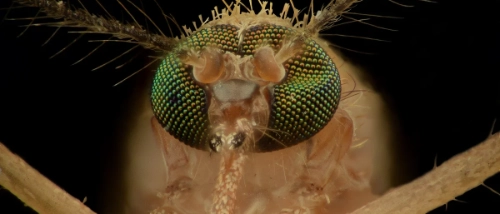
An extreme close-up of a mosquito's head showing its large, green-iridescent compound eyes made of thousands of tiny lenses

Eyes built for motion detection

Like many insects, mosquitoes have two large compound eyes located on either side of their head. These eyes are made up of thousands of tiny visual units called ommatidia, which work together to detect light, movement, and shapes.

Rather than seeing sharp details the way humans do, mosquitoes are much better at noticing motion and contrast. Their vision is designed to help them quickly detect hosts, avoid threats, and move through their environment.

Struggling with mosquitoes?

Call now to book your free inspection.

What do mosquitoes see?

Mosquitoes primarily see movement, dark shapes, and contrast. They are especially attracted to darker colors because these stand out more clearly against the horizon and the surrounding environment. 

Their eyesight becomes even more effective when combined with other sensory cues. Mosquitoes also rely heavily on carbon dioxide from breathing, body heat, sweat and body odors, humidity, and air movement for navigation.

This combination of senses helps mosquitoes zero in on humans and animals, even in dim lighting. Because they use so many different methods to find a host, effective pest control requires a comprehensive approach to manage their populations and nesting sites.
 

Can mosquitoes see in the dark?

Mosquitoes can see reasonably well in low-light environments, but they do not have perfect night vision. Their eyes are adapted for dawn, dusk, and shaded areas where they are most active; they function well in darker conditions. 

Even in darkness, mosquitoes continue to rely heavily on heat and carbon dioxide to locate hosts. That’s why simply turning off the lights doesn’t stop mosquitoes from finding people or pets nearby. 

Because these pests are so effective at tracking hosts regardless of the lighting, professional mosquito control is almost always necessary to deal with a persistent problem.

Need help with mosquitoes?

Because a mosquito's vision is specifically tuned to detect movement and dark shapes, reducing activity through specialized treatments is one of the best ways to keep your family and pets out of their line of sight. Call us, or click the button below for a free inspection.

Frequently asked questions

Mosquitoes do not see sharp detail the way humans do, but they are very good at detecting motion and contrast, especially in low-light conditions.

Mosquitoes can detect certain colors and are often more attracted to darker shades because they create stronger visual contrast.

Mosquitoes have compound eyes made up of thousands of tiny visual units called ommatidia, which work together to detect movement and light.

Mosquitoes have two compound eyes, each with many individual lenses that give them a broad field of vision and help them detect movement from multiple directions at once. Although mosquitoes don’t see fine detail particularly well, their eyes are highly sensitive to changes in light and motion, which helps them stay active during low-light conditions such as dusk and dawn.

See how Ehrlich helps protect your business.

Enjoy protection from 39 of the most common household pests with our annual residential pest control program, PestFree365+.