Temps and termites are on the rise. Schedule your free inspection today.

800-837-5520 Call us for a free quote Contact us

How to get rid of drain flies

It happens a lot more than most people think. Have you entered a kitchen to find the sink has a number of very small flying insects in it? What are these winged creatures? Are they flies? Are they gnats? Where do they come from? At Ehrlich pest control, we get a lot of calls about drain flies. Drain flies are a common household pest, but also common in restrooms and kitchens in offices.

At Ehrlich, we know how to help eliminate drain flies and are the experts in fly control and prevention.

What are drain flies?

Drain flies are small insects in the order Diptera, meaning they have a single pair of wings. They belong to the family Psychodidae and are sometimes called sink flies, sewer gnats, sewer flies, filter flies, or moth flies. They are very small, and the wings do not fold neatly over their back when they are not flying, but they stick out to the sides a bit, like a moth's wings.

There are a large number of varieties of drain flies within the scientific family known as Psychodidae. Drain flies prefer to live in and around very wet areas and lay their eggs in water. Drain flies tend to be nocturnal, so you are most likely to see them at night, although they are also attracted to light sources, so they have been known to appear during the day. They're weak fliers and often crawl along surfaces instead of flying in straight lines.

Drain flies thrive in damp places like pipes, sinks, and shower drains, laying their eggs in standing water and built-up organic matter—especially the biofilm that forms in drains and pipes.

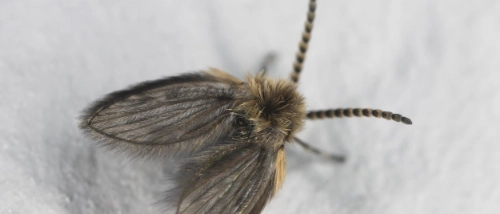
A close-up of a drain fly on a white wall.

What do drain flies look like?

Drain flies are called "moth flies" because when you look at them closely, you can see a number of dense hairs near and around the head. This, combined with their grayish or dark brown color and the shape of their wings, makes them look like tiny moths.

They are small, about one-sixth to one-fifth of an inch long. Their wings are leaf-shaped and covered in fine hairs, giving them a fuzzy appearance. Their coloring ranges from gray to dark brown. Unlike houseflies, drain flies don’t fold their wings flat when at rest; they stick out to the sides.

Their small size and erratic flight can make them hard to spot, but you’ll often notice them gathered around drains or near moist surfaces.

Their larvae are nearly transparent, save for a head that is black and can sometimes be seen moving along the wet edges of shower stalls or other wet areas within bathrooms.

Are drain flies harmful or dangerous?

For the most part, drain flies are neither dangerous nor harmful. Having drain flies around your home does not mean your drains are dirty or your kitchen, bathroom, or other areas are unclean. They are opportunistic insects and can get inside and find any moist area to lay their eggs and breed.

There is a sub-family of drain flies known as Phlebotominae, which are blood feeders. This sub-genre of drain flies are more commonly known as sand flies and are not very common in North America. However, because they feed on blood, like mosquitoes, they run the risk of transmitting some blood-related disease.

Seeing flies?

Call now to book your free inspection.

Why do I have drain flies?

Drain flies show up when conditions in your home give them what they need to survive: moisture and access to organic matter. This can build up inside drains in the form of food particles, grease, soap scum, or hair. When this organic debris collects, it often forms a layer of biofilm, a thin, sticky substance that creates the perfect spot for them to breed.

Common causes include slow-draining sinks or showers, water leaks, or not cleaning your drains regularly. If any of these conditions are present, it could explain why you have drain flies in your bathroom or kitchen.

How to get rid of drain flies

The best way to get rid of drain flies is to prevent them from finding organic matter in drains in which to nest. This means actually finding where food or hair has started to gather and physically removing any potential clogs or material. Drain cleaners have not proven to be effective in getting rid of drain flies.

Start by addressing the source. Drain flies tend to lay eggs in drains filled with organic debris, so the first step is to clean your drains by removing the organic matter.  Once you remove the clog or organic matter, this will get rid of any eggs or larvae. The adults that are already flying around will still be there, but their life span as an adult is only about 20 days, and without a place to breed or lay eggs, they will not continue their infestation.

Our fly control services are designed to find the root cause and help eliminate drain flies safely.

How to treat infested drains

Focus on removing the buildup inside your pipes. Use a stiff brush to scrub the inside of your drain, followed by hot water to flush it. For floor drains, cleaning under the floor plate grate and where it sits on the drain housing is also important. Avoid pouring unknown chemicals, especially near food prep areas.

DIY methods may help in the short term, but they often miss hidden organic matter deeper in the pipe. For reliable results, our technicians offer targeted solutions to remove organic matter and address hidden infestations.

Preventing drain flies from coming back

To help prevent drain flies from returning, keep drains dry and clear of buildup. Run hot water regularly through sinks, and avoid letting food, hair, or soap scum collect in drains. For sinks with integrated garbage disposal units, weekly cleaning by grinding a handful of plain ice cubes is also effective.

Ehrlich is here to help with expert solutions that clean drains and stop build-up. Our services are designed to help prevent drain flies from coming back.
When to call a drain fly exterminator

If you’ve tried to eliminate drain flies on your own but they keep returning, it’s time to call a fly exterminator. At Ehrlich, our technicians can help pinpoint the source, treat affected areas, and recommend prevention strategies.

Ehrlich pest control also offers a bioremediation drain line service that helps keep drains clean and free of buildup. We work with businesses throughout the country, utilizing our drain line service to prevent drain flies and unsanitary conditions from forming.

Frequently asked questions

Bleach may kill some larvae or adults near the surface of the drain, but it usually doesn’t reach the deeper sections where eggs and most larvae are hidden. This means it likely won’t stop the infestation entirely. 

Note: Do not use bleach if you are using a pest control company to provide bio remediation services, as it will kill the beneficial microbes that break down the fats, oils, and greases.

You may have a buildup of organic matter inside a pipe or a slow-draining sink that’s gone unnoticed. Moist, clogged drains create the perfect breeding site, and even a small amount of hidden debris can attract drain flies quickly.

Vinegar can help clean surface gunk and may deter adult flies temporarily, but it won't kill the eggs or larvae deeper in the drain. It's not a reliable way to get rid of a full infestation.

Pouring boiling water can help loosen debris and may flush out some larvae. While it's a simple first step, it won't reach eggs that are deeper or stuck in thick biofilm. Be cautious when using boiling water on old or plastic pipes.

Drain flies have fuzzy wings and rest near sinks, drains, or other damp areas. Fruit flies are smoother, more active during the day, and tend to hover near fruit, trash, or compost bins.

Find your local branch

Are seeing flies in your home during the late fall and winter? Those might be cluster flies. Learn more here.