© 2026 Rentokil Initial plc and subject to the conditions in the legal statement.
Quick overview
- One female mouse can produce 25 to 120 offspring in a single year.
- Mice breed at six weeks, and rats at about three months.
- A single breeding pair can multiply into hundreds within months.
- Milder winters mean rodents now breed nearly year-round.
- Early detection is the best way to stop rapid growth.
If you have ever spotted a single mouse in your facility and written it off as a one-off, the numbers tell a different story. Understanding how fast a rodent infestation can grow is the difference between a quick fix and a serious, costly problem. Rodents reproduce at a pace that catches most facilities managers off guard, and by the time you see one, there are usually many more out of sight.
Here is what the math actually looks like, and what it means for your building.
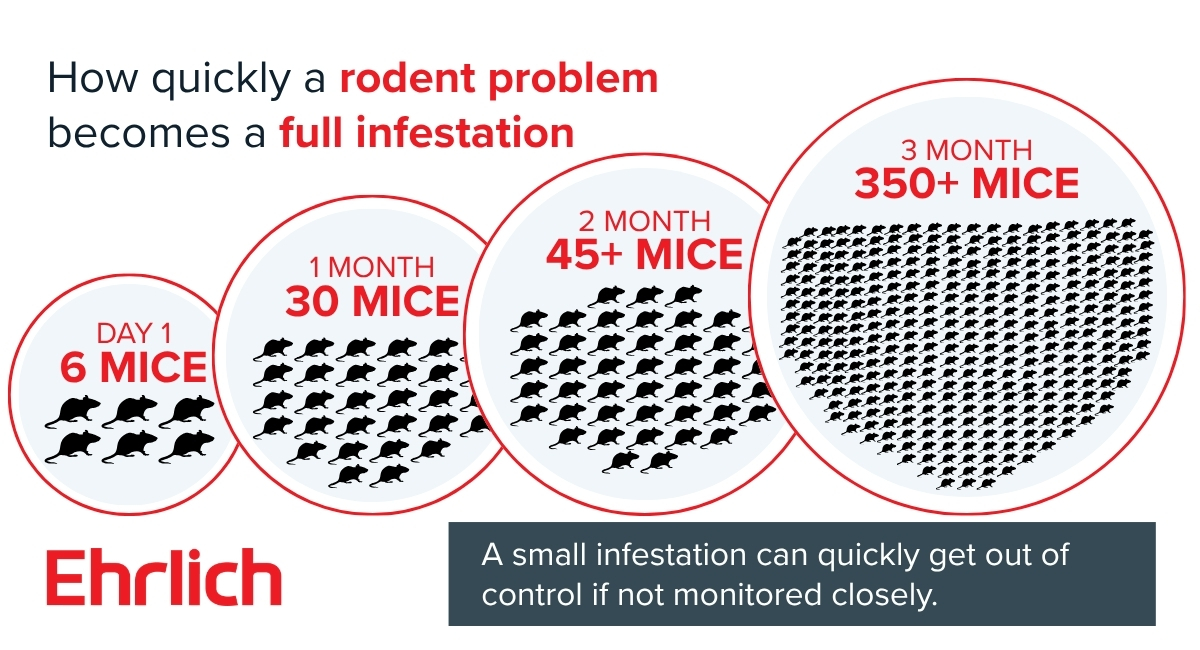
The math behind a rodent infestation
Rodents are built to multiply. Both mice and rats breed quickly, mature young, and produce litter after litter throughout the year. That combination is what turns a small problem into a big one so fast.
How fast do mice reproduce?
A female house mouse reaches breeding age in just six to eight weeks. Her pregnancy lasts only 19 to 21 days, and each litter brings five to 12 pups. She can also become pregnant again within days of giving birth. Add it up and one female can produce five to 10 litters a year, or roughly 25 to 120 offspring. Because those young start breeding within weeks, a single pair of mice can grow into hundreds within a year.
How fast do rats reproduce?
Rats follow the same pattern on a larger scale. A female rat is ready to breed at about three months, with a gestation of 21 to 23 days and six to 12 pups per litter. Most females raise five to seven litters a year. Under ideal conditions, the descendants of one breeding pair can climb into the thousands within 12 months.

Why infestations seem to appear overnight
This is why a rodent problem rarely stays small for long. Rodents are nocturnal and stay hidden, so you usually notice the signs of an infestation before you ever see the animal. Droppings, gnaw marks, grease marks along walls, and scratching in ceilings all point to a population that is already established. By the time activity is obvious, breeding has often been underway for weeks.
Warmer, shorter winters also play a part. Milder conditions let rodents stay active longer and produce more litters, so populations build faster than many facilities expect.
Rodent pressure is now a year-round issue
There was a time when rodents were mainly a cold-weather concern. That has changed. Rentokil's 2025 State of the Rodent Report, based on nearly 650,000 commercial services, found that peak activity is shifting toward spring and summer, the months when rodents breed most actively. Milder winters let more rodents survive and reproduce, so populations build earlier and stay high for longer. In the Northeast, where activity rose 4.5% in 2025, that breeding window now overlaps with your busiest operating months.
What rapid breeding means for your facility
For a commercial building, the speed of reproduction changes how you should think about risk:
- A single sighting can signal an established nest, not a lone visitor.
- Visits scheduled every few weeks can miss the early stages of a fast-growing population.
- In food production, healthcare, and hospitality, even minor activity can trigger audit findings or a failed inspection.
The facilities that stay ahead treat rodent control as something continuous, not occasional. When you protect a commercial site, the goal is to catch activity before the breeding cycle takes hold.
Under favorable conditions, with steady food, water, and shelter, a rodent population can double within a few months.
Yes. A heated building with food and water lets rodents breed year-round, even when outdoor conditions turn cold.
There is no fixed number. Because breeding is so fast, any confirmed activity is best treated as a developing problem rather than a one-off.
Get ahead of rodent reproduction with PestConnect
Because rodents multiply so quickly, catching activity early matters more than almost anything else. PestConnect uses connected monitoring devices to track rodent activity around the clock and alert your local Ehrlich team the moment something is detected, so a small problem gets handled before it becomes a colony.
To put continuous protection in place for your facility, request a free inspection with your local Ehrlich team.
Schedule your free pest inspection today
Get peace of mind knowing your home or business is protected. Our technicians will assess your property and recommend customized solutions.
Book your free pest inspection today
Our local technicians will assess your property and recommend tailored solutions. Fast, friendly, and completely obligation-free.
- Targeted treatments, applied safely
- Local experts, fast response
- Trusted, trained technicians