© 2026 Rentokil Initial plc and subject to the conditions in the legal statement.
Quick overview
- Traditional pest control relies on scheduled visits with gaps in between.
- Connected pest control monitors your facility 24/7.
- Real-time alerts mean faster response to rodent activity.
- Connected monitoring can cut rodenticide use by up to 60%.
- Rodent pressure is now year-round, raising the cost of gaps.
If you manage a commercial building, you already know pest control is not optional. The real question is how it gets done. Traditionally, the answer was a technician on a set schedule. Now, a connected model offers something different. Understanding traditional vs connected pest control helps you choose the approach that actually fits how rodents behave today, and how your facility runs.
Here is how the two models compare, and what the difference means for your site.
How traditional pest control works
The traditional model is built around scheduled visits. A technician comes on a fixed cycle, inspects bait stations and traps, logs what they find, and then conducts reactive measure based on findings.
With a skilled tech, this process is effective to a point but has its limitations. Between visits, no one is watching. If rodent activity starts the day after a service, it can go unnoticed until the next scheduled stop, sometimes months later. Given how quickly rodents breed, those gaps give a small problem room to grow.
In addition, this model only allows the technician to respond to what they can see during a visit, rather than to what has happened since the last visit.
How connected pest control works
Connected pest management addresses those weaknesses with technology. Instead of relying only on periodic checks, connected devices monitor your facility around the clock.
Continuous monitoring and alerts
Connected units detect rodent activity in traps and exterior bait stations 24 hours a day. When a device is triggered, it sends a real time alert to your local Ehrlich team, who can respond quickly rather than waiting for the next scheduled visit. That shift from scheduled processes to proactive is the core difference between the two models.
Better data for better decisions
Because activity is logged automatically, you get a clearer picture of what is happening across your site over time. Patterns that are easy to miss during a single walkthrough become visible, which helps target treatment where it is actually needed. For facilities in food production, healthcare, and hospitality, that continuous record also supports audit and compliance documentation.
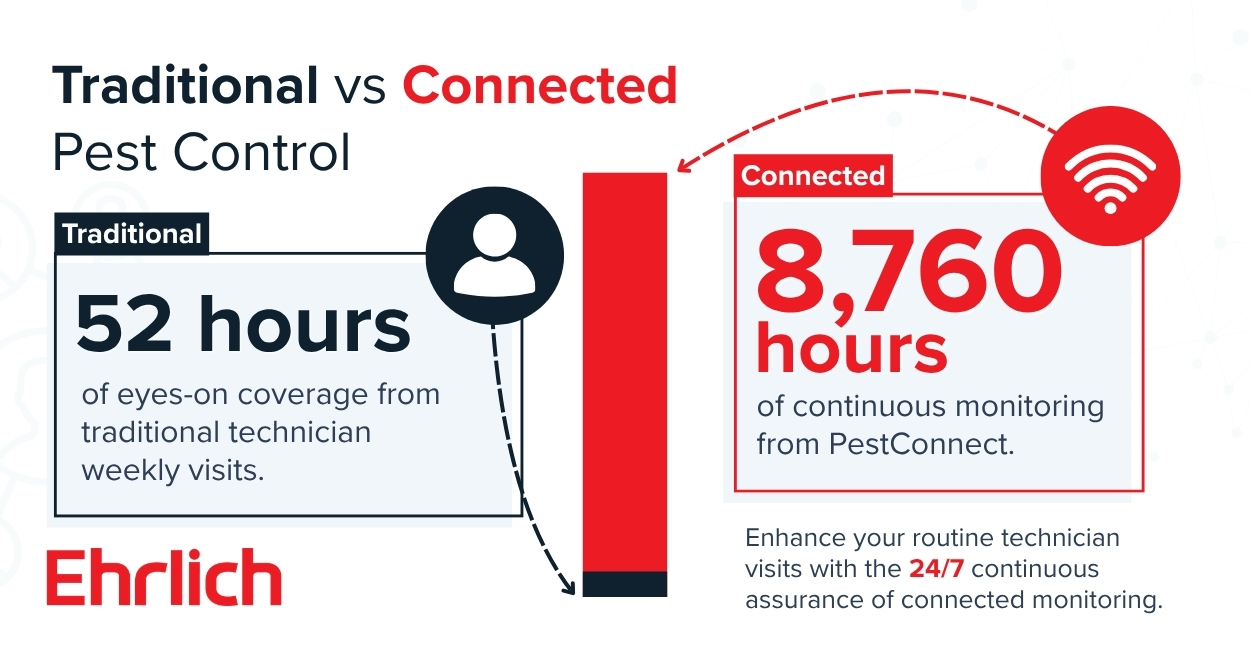
Comparing the two models
Put side by side, the practical differences come down to timing, visibility, and response:
- Coverage: scheduled checks versus continuous 24/7 monitoring.
- Response: waiting for the next visit versus a real time alert.
- Approach: reacting to what is visible versus acting on live activity.
- Chemical use: routine application versus targeted treatment only where needed.
That last point carries real weight. According to Rentokil's data, connected monitoring through PestConnect has been shown to reduce rodenticide use by up to 60%, because problems get resolved before they escalate. As more states tighten rules on rodenticide use, that reduction is becoming a practical advantage, not just an environmental one.
Which model fits your facility?
Connected monitoring is not about replacing skilled technicians; it’s about providing them with deeper intelligence, regardless of the site’s status. For facilities with constant pest pressure, the data offers granular insights that help technicians optimize their work while on-site. For facilities where pests are already controlled, continuous monitoring provides the ongoing assurance needed to maintain that status and minimize future risk.
For any commercial facility where a rodent issue could mean a failed inspection or halted production, a connected approach—paired with expert rodent control—closes the gaps that matter most.
.f0275b8a43d5c77f5b6dc220adfabf43.webp)
See connected pest management in action with PestConnect
The gap between traditional and connected pest control comes down to one thing: how fast we can respond and hence reduce the time frame and magnitude of any infestation. PestConnect uses connected monitoring devices to track rodent activity 24/7 and alert your local Ehrlich team the moment something is detected, so issues get handled before they grow. To see how continuous monitoring would work for your facility, request a free inspection with your local Ehrlich team.
Schedule your free pest inspection today
Get peace of mind knowing your home or business is protected. Our technicians will assess your property and recommend customized solutions.
Book your free pest inspection today
Our local technicians will assess your property and recommend tailored solutions. Fast, friendly, and completely obligation-free.
- Targeted treatments, applied safely
- Local experts, fast response
- Trusted, trained technicians