© 2026 Rentokil Initial plc and subject to the conditions in the legal statement.
Quick overview
- Workers keep the colony running for weeks or months after the queen dies.
- No new eggs means the colony's population will gradually decline over time.
- Some species can raise a replacement queen or merge with another colony.
- A dead queen doesn't guarantee your ant problem is solved.
- Professional treatments target the queen to address the colony at its source.
Every ant colony revolves around one insect: the queen. When she dies, the colony doesn't collapse overnight, but the effects ripple through every part of the nest. Understanding what actually happens can help you make sense of any activity you're seeing around your home, and why a single dead queen ant rarely solves an infestation.
The queen ant's role in the colony
The queen is the only member of most ant colonies that lays eggs. She can produce thousands, sometimes millions, of eggs over her lifetime, and every worker, soldier, and future queen in the nest typically traces back to her. Worker ants spend their lives feeding her, grooming her, and protecting her deep within the nest, because without her, the colony has no way to replace the workers it loses. This is why our professional ant control services target the queen as well as the workers.
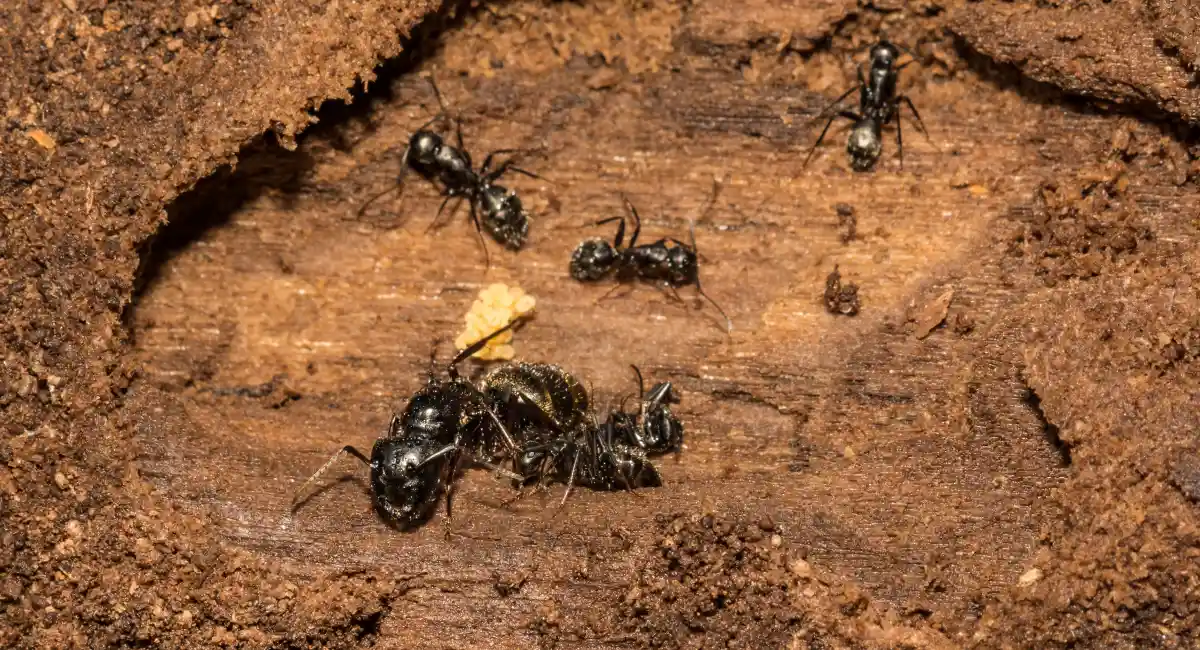
What happens when a queen ant dies?
Once the queen dies, egg production stops. This doesn’t mean the colony will vanish immediately, though. Workers will continue their usual jobs, foraging for food, tending to existing larvae, and maintaining the nest, sometimes for weeks or months. But without new eggs being laid, the population has no way to renew itself.
Over time, as existing workers die off naturally, the colony shrinks. In species with only one queen, this decline is usually permanent unless something changes. This is part of why professional treatments aim to reach the queen directly. Baiting systems, for example, are designed so that worker ants carry the bait back to the nest and pass it along until it reaches the queen.
What do ants do when the queen dies?
How ants behave after a queen's death depends heavily on the species. In some colonies, workers may attempt to raise a replacement queen from existing larvae, provided the right conditions and nutrition are available. In others, particularly species with multiple queens, such as certain carpenter ants, the colony simply continues under its remaining queens.
Some species can also merge with a nearby colony or "bud" off a group of workers to join another nest that still has an active queen. This adaptability is one reason ant colonies can be so persistent, and why homeowners sometimes see activity return even after treating a visible nest.
Why professional treatment targets the queen
Because colony survival can depend so heavily on the queen, effective ant control focuses on reaching her, not just the ants you can see. Our technicians use a combination of baiting systems and nest treatments designed to work their way back to the source. Baits are carried by foraging workers directly to the queen, helping to halt reproduction and address the colony from the inside out.
Every property and infestation is different, which is why we start with a full inspection to identify the ant species, locate nesting areas, and determine the best combination of treatments. If you're dealing with ants that keep coming back despite your best efforts, it's often a sign that the colony's core, and its queen, haven't been reached yet.
Book your free pest inspection today
Our local technicians will assess your property and recommend tailored solutions. Fast, friendly, and completely obligation-free.
- Safe, targeted treatments
- Local experts, fast response
- Trusted, trained technicians