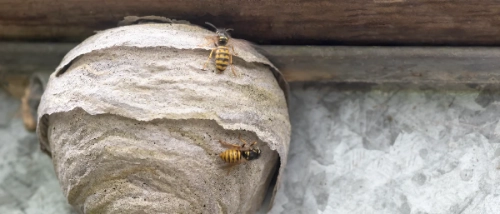
How a queen starts a wasp nest from scratch
Every social wasp colony begins with a single mated queen. She spends winter hibernating somewhere sheltered, such as under loose bark, in a woodpile, or tucked into a gap in your siding. Once temperatures climb into the 50s and 60s Fahrenheit, she wakes up and gets to work.
At this stage, she's doing every job herself. She picks a nest site, often under an eave, inside a wall void, or in a tree cavity, and starts building the first few cells out of chewed wood fiber mixed with saliva. She lays an egg in each one, then leaves the nest to hunt insects to feed her larvae once they hatch.
This solo phase is risky for the queen and lasts roughly four to six weeks until her first batch of workers is ready to take over.
The four stages of a wasp: egg, larva, pupa, and adult
Every individual wasp, whether it grows up to be a worker, a male, or a future queen, passes through the same four stages:
- Egg – laid singly in a cell, hatching within about a week
- Larva – a small, legless grub fed on chewed insects, growing through several molts
- Pupa – the larva seals itself in with a silk cap and transforms into an adult wasp
- Adult – the wasp chews its way out and starts working within hours
From egg to adult usually takes around three to five weeks, depending on the species and the weather.