© 2026 Rentokil Initial plc and subject to the conditions in the legal statement.
Updated on: 17 September 2026
Quick overview
- Worker wasps typically live 12 to 22 days, while queen wasps can survive up to a year
- Queens overwinter in sheltered spots and emerge in spring to start new colonies
- Paper wasp and yellowjacket colonies typically last three to twelve months
- Wasps trapped indoors or separated from their nest rarely survive more than a few days
- Unmated wasps die off by late summer to early fall since mating is their main purpose
Worker wasps typically live 12 to 22 days, while queen wasps can live up to a year. Meanwhile, queens overwinter and emerge in spring to establish new colonies.
Understanding when wasps are most active can help you better manage wasp activity around your home, especially during peak summer seasons.
Paper wasp life cycle
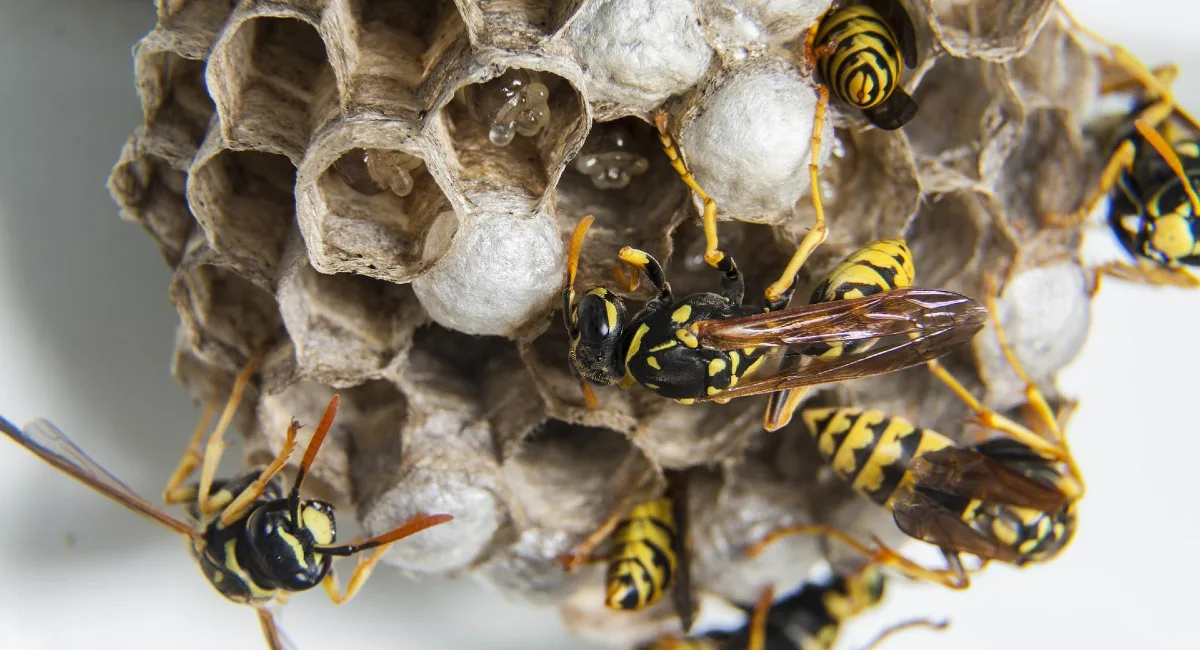
Paper wasps or Polistes spp are somewhat social insects and they have three different caste systems, which are queens, workers and males.
When the queens are fertilized, they spend their winters in sheltered areas like underneath tree barks, or crevices found in homes or other buildings. The queen then selects their nesting area and builds it in the spring.
The eggs are laid down and then hatched into larvae. Paper wasp larvae will develop in stages before becoming an adult. Workers will help build the nest, feed the young, and protect the nest. When a paper wasp nest matures it can hold anywhere between 20-30 adults. The queen will stop laying eggs in the late summer and shortly after the colony will die off; which will make it around 3-4 months for workers and 10-12 months for queens.
Yellowjacket wasp life cycle

Yellowjackets or Vespula vulgaris are also social insects, and are able to build their nests the size of a basketball. Yellowjackets share similar nesting habits to paper wasps, where the queen will find shelter in the winter and seek a nest in the spring.
However, because of the queen’s ability to store sperm, the queen is able to lay eggs throughout the summer, and will run out at the end of the season. This makes the life cycle of this type of queen wasp anywhere from 10-12 months.
Red wasp life cycle

Red wasps, or Polistes carolina, are a type of paper wasp. They follow the same basic life cycle as their relatives: egg, larva, pupa, and adult.
A fertilized queen emerges from hibernation in spring and builds a small nest, laying one egg per cell. Eggs hatch into larvae within about a week, and the queen feeds them until they pupate and mature into adult workers. As the colony grows through summer, workers take over nest-building, foraging, and feeding duties, while the queen focuses on laying eggs.
By late summer, egg production slows, and the colony begins to decline as temperatures drop.
Queen wasp life cycle
A queen wasp follows a different pattern than the rest of her colony. After mating in the fall, she spends winter hibernating in a sheltered spot, such as under hornet nest debris, tree bark, or a gap in a building.
Once she emerges in spring, she starts a nest alone, laying eggs and raising the first batch of workers by herself. From there, her workers take over daily tasks while she focuses on egg production through the summer. Queens can live up to a year, far longer than workers, which typically survive only a few weeks.
How long do wasps live indoors?
A wasp trapped indoors usually doesn't survive long unless it has access to food and water. Without these resources, it may only last a few days before dying. If a nest is actually located inside a wall void or attic space, though, wasps can continue living and building activity as usual.
How long do wasps live without food?
Wasps have fast metabolisms and need a steady food supply to stay active. Without food, most wasps will die within a few days, as they can't sustain their energy needs for long. This is part of why wasps become more aggressive scavengers in late summer and fall, when natural food sources like insects become harder to find, and they seek out sugary or protein-rich alternatives instead.
How long do wasps live without a nest?
Wasps rely heavily on their nest for shelter, temperature regulation, and raising their young, so losing access to it can considerably shorten their lifespan. A wasp separated from its nest still needs to find food and shelter on its own, which becomes more difficult without the support of its colony.
Wasps can die of loneliness
Wasps are very social creatures and will build many colonies based on how well they mate. Since the purpose of a wasp's life is to mate and/or create offspring, unmated wasps will eventually die off. Any unmated wasp, male or female, will perish around late summer to early fall.
Wasps also play a role in controlling insect populations, as wasps prey on and feed on insects, helping to manage pest numbers in their environment.
Need help with wasps?
If you spot a few wasps in your garden or around your property, chances are there is a nest nearby. Wasps, no matter what the species, can be very dangerous if you do not know how to handle them. These insects can get very hostile when their nests are disturbed, and they will sting if you get too close.
There is also no telling how big the nest may be or how mature the nest is until a professional inspects it. For those who are allergic, these stings can be fatal. This means relying on wasp control professionals is essential to staying safe.
If you have wasps in or around your property, please contact Ehrlich Pest Control.
Book your free pest inspection today
Our local technicians will assess your property and recommend tailored solutions. Fast, friendly, and completely obligation-free.
- Safe, targeted treatments
- Local experts, fast response
- Trusted, trained technicians